


Buy or Sell With Confidence
Don't let battery uncertainty cost you thousands. Whether you're buying a used EV or selling your own, a VoltScore report gives you the proof you need to negotiate with confidence.
Confidence starts with knowing your EV's battery health. Get a trusted, third-party battery health report before you buy—or anytime you want peace of mind. Just $89.95 at any certified location.
🔋 Trusted at certified locations across Canada
Supported EV Brands











Your EV's dashboard only tells part of the story. VoltScore gives you the complete picture of your battery's health with data you can trust.
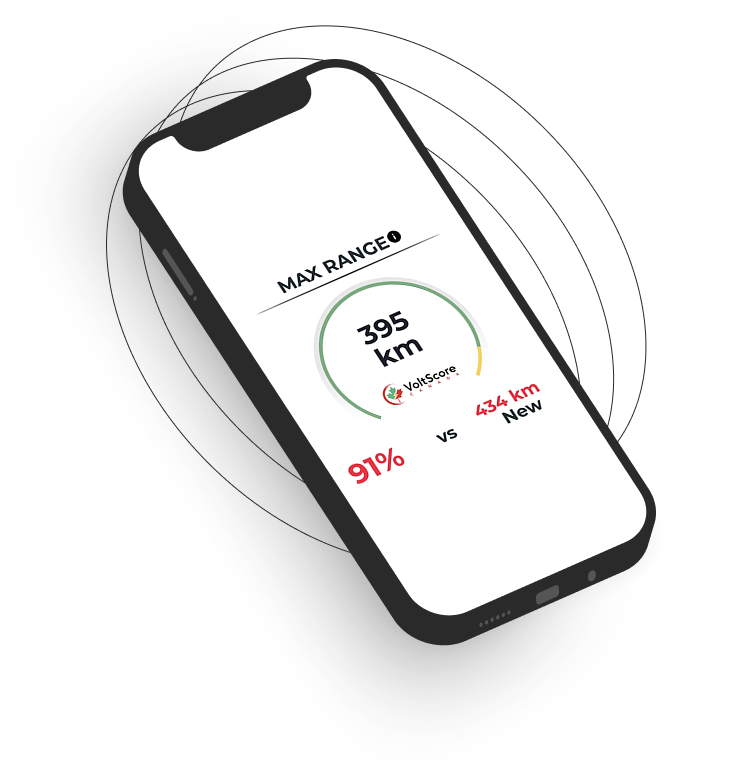
How much usable capacity remains and what that means for your real-world range.
A certified percentage score showing your battery's overall condition.
How well your battery accepts and holds a charge compared to when it was new.
How much life is left and whether degradation is within normal range for your vehicle.
Battery temperature management health — critical for longevity and safety.
Where your battery sits relative to warranty thresholds and expected lifespan.
When it comes to EVs, battery health shouldn't rely on assumptions or sales claims. VoltScore delivers a clear, unbiased battery health report designed to put you first.


Get your battery health report in three simple steps.
Use our map to find a certified VoltScore testing location near you.
The test takes just 90 seconds to 2 minutes. No appointment needed at most locations.
Receive a detailed battery health report you can use for buying, selling, or peace of mind.
Don't let battery uncertainty cost you thousands. Whether you're buying a used EV or selling your own, a VoltScore report gives you the proof you need to negotiate with confidence.
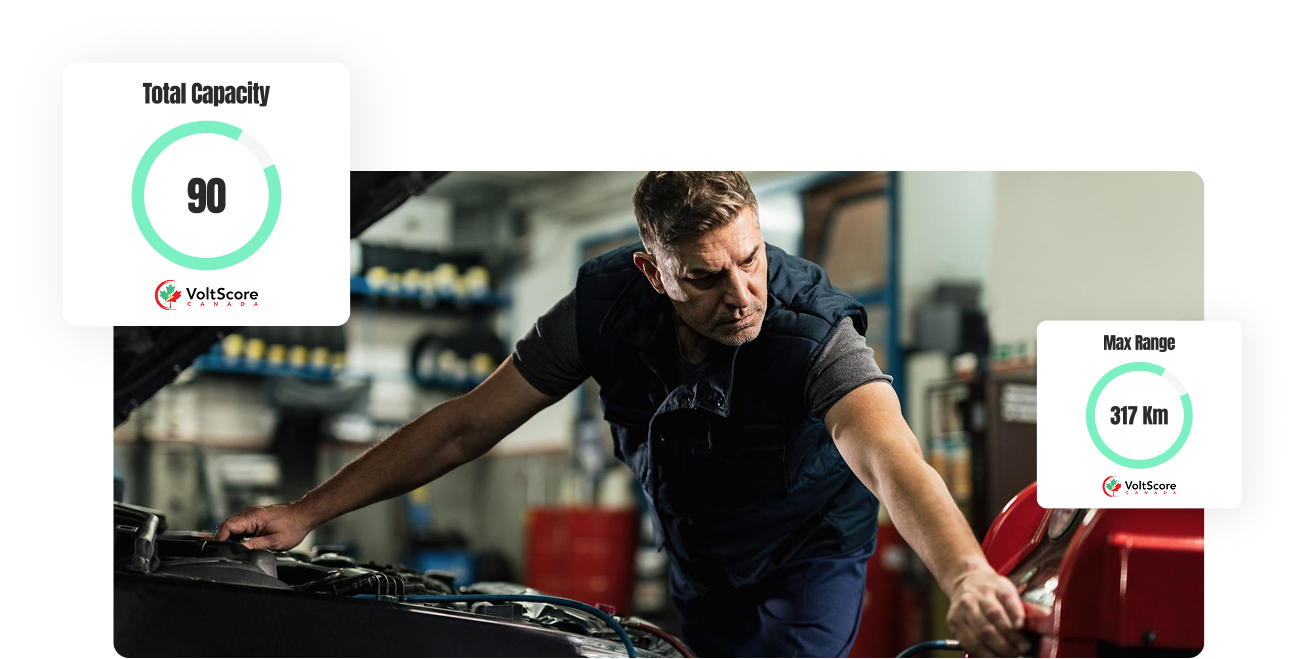
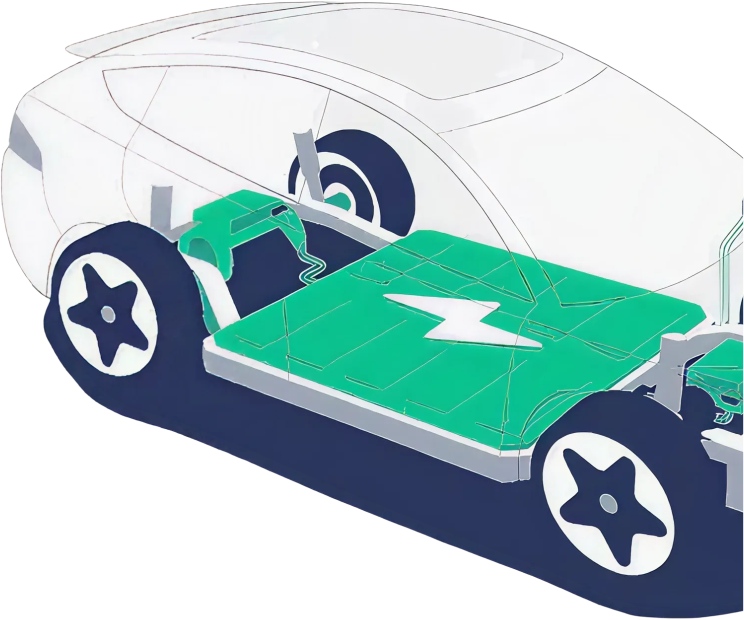

VoltScore checks the 3 most important indicators of battery health:
How much life is left in your battery
Is your battery likely to fail early?
Signs of damage you can't see on the dash
We support most EVs and hybrids on the road today - and we're adding more models every week.
Acura ZDX, 2024 - Current
Audi e-Tron, 2019 - Current
BMW i4, 2022 - Current
BMW iX, 2022 - Current
Cadillac LYRIC, 2022 - Current
Chevrolet Blazer EV, 2023 - Current
Chevrolet Bolt EV, 2017 - 2023
Chevrolet Bolt EUV, 2022 - 2023
Chevrolet Equinox EV, 2024 - Current
Fiat 500E, 2013 - 2019
Ford F-150 Lightning, 2022 - Current
Ford Mustang Mach E, 2021 - Current
Genesis GV60, 2023 - Current
Genesis G80 Electrified, 2023 - Current
Honda Prologue, 2024 - Current
Hyundai Ioniq 5, 2022 - Current
Hyundai Ioniq EV, 2017 - 2022
Hyundai Kona Electric, 2018 - 2023
Kia EV6, 2022 - Current
Kia Niro EV, 2019 - Current



Find a certified VoltScore testing location near you and get your battery health report today.

Learn more about how VoltScore works and what your battery health report will tell you.
EV batteries typically follow a pattern, where there is an
initial small drop in capacity over the first year or so, a
steady marginal decline over 5-10 years, and then a deep drop
over a year+ as the battery is getting to its end of life. A
low battery replacement risk indicates that a battery is not
exhibiting any signs of entering the final phase towards its
end of life.
Hybrid batteries typically follow a different pattern, where
there is an even drop in capacity over time, with a steep drop
as the battery is getting to its end of life. A low battery
replacement risk indicates that a battery is not exhibiting
any signs of entering the final phase towards its end of life.
Cells rated "fair" are showing early signs of degradation but are still functional. "Failing" cells have significantly reduced capacity compared to the pack average, which can affect range and performance. A few fair cells are common in older batteries, but multiple failing cells may indicate the battery is approaching end of life. Your VoltScore report includes specific recommendations based on your results.
Manufacturer warranties typically only cover complete battery failure — not gradual degradation. Your battery could lose 20-30% of its original capacity and still not qualify for a warranty claim. A VoltScore report gives you an objective snapshot of actual battery health, so you know exactly where you stand whether you're buying, selling, or just planning ahead.
We recommend testing annually as part of regular maintenance, or before any major transaction (buying or selling). If your vehicle is over 5 years old or has more than 100,000 km, more frequent testing (every 6 months) can help you catch degradation trends early and plan accordingly.
Your car's dashboard estimate is based on recent driving habits, climate, terrain, and other variables — it's a prediction, not a measurement. The VoltScore report measures actual cell-level data directly from the battery management system, giving you the true usable capacity compared to the manufacturer's original specification. Think of it as the difference between a fuel gauge estimate and actually measuring what's in the tank.
A basic battery check only looks at overall capacity — like checking if a bucket is full. A full VoltScore report examines every individual cell, identifies early degradation patterns, and assesses premature failure risk. A battery can appear healthy at the surface level while having individual cells that are deteriorating faster than the rest, which will eventually cause problems. The full report catches what basic checks miss.
This can happen because replacement risk looks at the overall degradation trajectory of the battery, not just individual cell health. Even if all cells are currently performing well, the rate at which the battery is losing capacity may indicate it's on a path toward needing replacement sooner than expected. Think of it like a car with a good engine but high mileage — the parts are fine today, but the trend line matters.
New batteries can show small voltage differences between cells during their break-in period. This is normal and typically balances out within a few charge cycles. If the differences persist or grow over time, it may indicate a manufacturing defect worth investigating under warranty.